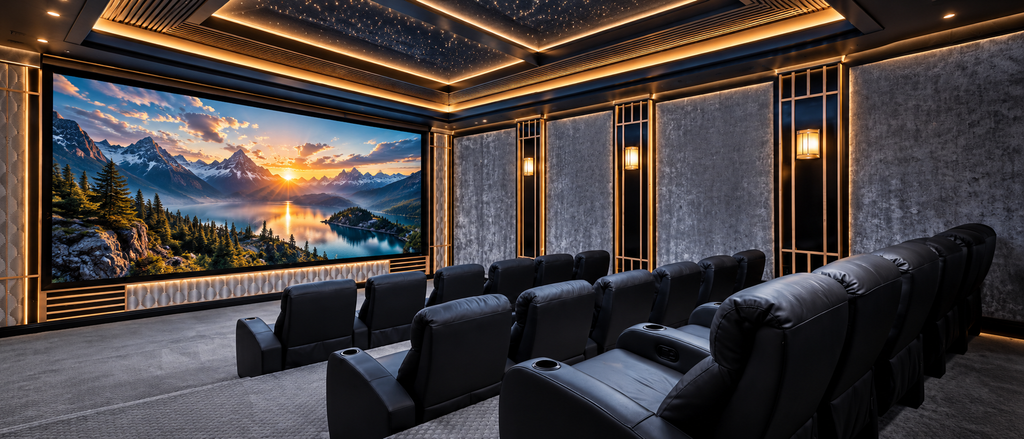
A great home theater does not start with the biggest screen. It starts with the right screen for your room, viewing distance, budget, and lifestyle.
Many homeowners think they must buy a huge television or a 150-inch projector screen before they can enjoy a real home theater experience. That is not true.
At Home Cinema 4U, we can design a home theater around many different TV and projector screen sizes. If you already have a TV that works well in your room, we can build the theater experience around it. And if you have the space and budget for a large private cinema, we can also design a premium projector setup with a very large screen, Dolby surround sound, modern lighting, comfortable seating, and smart controls.
The goal is simple: make your room feel like a real theater without forcing you to buy equipment you do not need.
What Makes a Screen Right for a Home Theater?
The right home theater screen depends on more than its size.
Before choosing a TV or projector screen, think about:
- Room size
- Viewing distance
- Number of seats
- Room lighting
- Windows
- TV or projector preference
- Audio system
- Budget
- How often you use the room
- Movies, gaming, sports, or everyday TV use
A very large screen in a small room may actually be uncomfortable. At the same time, a small display in a very large theater room may not give you the immersive feeling you want.
The best setup keeps the screen, seating, audio, and room size in balance.
Do You Need a Huge Screen for a Home Theater?
No.
This is one of the most common misunderstandings about home theaters.
You can create a beautiful theater experience using a suitable television that you already own. A home theater is not defined only by screen size.
A complete setup can include:
- Quality TV or projection screen
- Surround sound
- Dolby-style audio
- Subwoofer
- Proper speaker placement
- Comfortable seating
- Modern ambient lighting
- AV receiver and equipment
- Smart controls
- Acoustic improvements
When all these parts work together, even a normal-sized screen can feel much more exciting.
So if you have a TV and want to turn your room into an entertainment space, you do not automatically need to replace it.
Want a Huge Cinema Screen? We Can Build That Too
Some customers want something completely different.
They want to walk into a room and feel like they have entered their own private movie theater.
If you have the room and budget, Home Cinema 4U can design a large projector-based theater system as well.
Common projector screen sizes can include:
100-inch, 110-inch, 120-inch, 135-inch, 150-inch, 165-inch, 180-inch, 200-inch, and custom large-screen options.
The final screen size should be selected after checking the room dimensions, projector location, seating distance, ceiling height, viewing angle, and budget.
A premium large-screen theater can be combined with:
- 4K projector
- Large fixed or motorized screen
- Dolby Atmos-style surround sound
- Multiple speakers
- Powerful subwoofers
- Acoustic treatment
- Luxury theater recliners
- Smart lighting
- Motorized shades
- AV equipment rack
- Home automation
- Clean professional wiring
This is where a normal room can become a true private cinema.
TV Screen or Projector Screen: Which Is Better?
There is no single answer.
Both can be excellent.
TV-Based Home Theater
A large TV is often a smart choice for a:
- Living room
- Family room
- Bedroom
- Small entertainment room
- Gaming room
- Multipurpose space
Modern TVs provide a bright, sharp image and work well even when some room lighting is on.
They are also simple for everyday use.
You can watch movies, streaming services, sports, television, and play games without making the entire room dark.
Projector-Based Home Theater
A projector is a great choice when you want a larger cinematic picture.
It works especially well in:
- Dedicated theater rooms
- Finished basements
- Large entertainment rooms
- Media rooms
- Rooms with controlled lighting
A large projected image gives a different feeling from watching a regular television.
If your main goal is a private cinema experience, a properly designed projector system can be a great option.
How Large Should Your Home Theater Screen Be?
There is no magic screen size that fits every home.
Screen size should be matched with viewing distance.
For example, if your seats are very close to the screen, an extremely large image may feel uncomfortable. You may have to move your eyes and head constantly to follow the picture.
If your seating is far away, a small screen may not feel immersive enough.
This is why we recommend planning the screen and seating together.
Instead of asking:
“What is the biggest screen I can buy?”
A better question is:
“What screen size will give me the best experience from my seating position?”
Professional planning helps answer this before equipment is purchased and installed.
Fixed Frame Projector Screens
A fixed-frame projector screen stays permanently mounted on the wall.
This is often a great choice for dedicated home theaters.
It provides a clean cinema-style appearance and allows the rest of the room to be designed around the screen.
Speakers, lights, seating, acoustic panels, and room finishes can all be placed to support the viewing experience.
If the room is mainly used for movies and entertainment, a fixed screen can make a lot of sense.
Motorized Projector Screens
A motorized screen can roll down when you need it and disappear when you are finished.
This makes it useful for spaces that have more than one purpose.
For example:
- Living rooms
- Offices
- Conference rooms
- Bedrooms
- Family rooms
- Multipurpose spaces
A motorized screen can also work with a smart control system.
Imagine pressing one button and having the screen lower, the projector turn on, the lights dim, and the shades close.
Our home automation solutions can help bring different parts of your entertainment space together.
Screen Brands and Equipment Should Match Your Budget
There are many display, projector, screen, audio, lighting, and control brands available.
We do not believe every customer needs the same brand or the most expensive equipment.
Instead, the products should be selected based on:
- Room size
- Screen size
- Picture quality
- Audio needs
- Lighting
- Budget
- Installation type
- Personal preference
A lower-cost system designed correctly can sometimes provide a better experience than expensive equipment installed without proper planning.
Home Cinema 4U can help you compare suitable products and select equipment that works together within your budget.
You can explore manufacturers and product options on our Brands page.
Sound Is Just as Important as Screen Size
You can have a huge screen, but without good sound, the theater experience may still feel incomplete.
Audio makes movies feel alive.
Imagine watching an action scene.
The picture is in front of you, but good surround sound makes you hear action around the room. Dialogue comes clearly from the front. Music fills the space. Bass gives impact to action scenes.
A Dolby-style surround setup can include front speakers, center speakers, surround speakers, ceiling speakers, and subwoofers based on the room.
Our professional audio installation service can help create a system designed around the seating position and room layout.
Modern Lighting Changes the Entire Room
Lighting can make a normal entertainment room feel much more premium.
A good home theater should not simply be completely dark.
Different lighting modes can be useful for different situations.
For example:
Movie Mode – main lights dim while soft accent lights remain on.
Gaming Mode – enough light stays on to keep the room comfortable.
Intermission Mode – pathway lights come on without making the entire room bright.
Cleaning Mode – all room lighting becomes bright.
With smart lighting installation, lighting can become part of the theater experience instead of being just a regular switch on the wall.
Control Sunlight With Motorized Shades
Windows can sometimes create problems for projector systems.
Bright sunlight can reduce contrast and make the image harder to see.
That does not mean a room with windows cannot become a theater.
Professional window treatments and motorized shades can help control natural light.
In an automated setup, the shades can even close when movie mode starts.
Lights dim.
Shades close.
Projector turns on.
Sound system starts.
Your room is ready.
Comfortable Seating Is Part of the Theater
A cinema experience is not complete if you are uncomfortable after 30 minutes.
Seating position should be planned based on both the screen and speakers.
Depending on the room, you may use:
- Premium leather recliners
- Cushioned theater chairs
- Sectional sofas
- Individual seats
- Multiple rows of seating
For larger rooms, raised second-row seating may also help improve the view.
The goal is to give every person a comfortable view of the screen while keeping them in a good listening position.
AV Equipment Rack for a Clean Setup
A professional home theater can include several pieces of equipment behind the scenes.
These may include:
- AV receiver
- Amplifiers
- Streaming equipment
- Network devices
- Control processors
- Power management
- Audio/video equipment
Instead of keeping everything around the screen, these devices can be organized inside an AV Equipment Rack, also called an Audio/Video Rack.
A well-organized rack helps keep the theater clean and makes equipment easier to manage and service.
Your Internet Connection Matters Too
Modern home theaters depend heavily on the internet.
Streaming movies, music, online gaming, smart lighting, automation, and other devices all require a stable network.
A great screen and sound system cannot fix constant buffering.
For this reason, Wi-Fi and networking should also be considered during the theater design.
Our Networking & Wi-Fi installation services can help improve coverage and connections for your entertainment equipment.
Projector and Screen Installation for Offices
Home Cinema 4U is not limited to residential home theaters.
We can also install projector and screen systems for office and business use.
Professional projector setups can be useful for:
- Conference rooms
- Meeting rooms
- Training rooms
- Presentation rooms
- Business offices
- Learning spaces
- Client presentation areas
An office setup can include a projector, fixed or motorized screen, speakers, HDMI connections, networking, wireless presentation equipment, and clean cable management.
The screen size and projector should be selected according to the room size, seating, lighting, and presentation needs.
A well-installed business projector system makes presentations easier for everyone in the room to see and follow.
We Can Design Simple or Premium Home Theaters
Every customer has a different budget.
That is completely normal.
One homeowner may want to improve an existing TV room.
Another may want a 120-inch projector screen.
Someone else may want a 150-inch or larger private cinema with premium seating, Dolby Atmos sound, acoustic treatment, lighting automation, and an equipment rack.
We can design the system based on your goals.
You do not need to buy equipment simply because it is expensive.
You need equipment that is right for your room.
See Our Home Theater Projects
Sometimes the easiest way to understand what is possible is to see completed installations.
Visit our Projects page to explore home theater ideas and different room setups.
Real projects can also help you decide what style, screen, lighting, seating, and audio arrangement you prefer.
Build Your Home Theater in New Jersey
A home theater can be simple, advanced, compact, or extremely luxurious.
It does not have to follow one fixed formula.
At Home Cinema 4U, we can design your entertainment space around the screen size you already have or help you build a large projector-based private theater from the beginning.
From the display and projector to Dolby-style audio, lighting, comfortable seating, AV equipment, networking, and smart controls, the entire system can be planned around your room and budget.
Whether you want to upgrade a family room, transform a basement, create a luxury dedicated theater, or install a projector and screen for your office, we can help.
Ready to discuss your project?
Visit our Contact Us page or contact us directly.
Home Cinema 4U
Phone: +1 631-830-9033
Email: info@homecinema4u.com
Address: 5 Jasmine Dr, Monroe Township, NJ 08831
Frequently Asked Questions
What is the best screen size for a home theater?
There is no single best size. It depends on your room dimensions, viewing distance, seating position, display type, and budget. The screen should feel immersive without becoming uncomfortable to watch.
Do I need a 100-inch screen for a home theater?
No. A home theater can be created around many TV and projector screen sizes. Sound, lighting, seating, and room design are also major parts of the experience.
Can you install a 150-inch or 200-inch projector screen?
Large projector screens can be installed when the room dimensions, projector, viewing distance, and budget support the setup. Large or custom screen systems should be professionally planned before equipment is purchased.
Can my existing TV become part of a home theater?
Yes. An existing TV can be combined with surround sound, subwoofers, modern lighting, comfortable seating, smart controls, and other AV equipment to create a more immersive home theater experience.
Is a projector better than a TV for a home theater?
It depends on the room. Projectors are excellent for very large cinema-style images, while TVs can be better for bright rooms and everyday viewing.
What type of projector screen should I choose?
Dedicated theaters often work well with fixed-frame screens, while motorized screens can be useful in living rooms, offices, and multipurpose spaces. The correct choice depends on how you use the room.
Can you recommend equipment based on my budget?
Yes. Equipment can be selected according to room size, performance needs, installation requirements, and budget. Visit our Brands page to explore available solutions.
Do you install Dolby surround sound?
Home theater audio can be designed with immersive Dolby-style surround configurations based on the room, seating arrangement, speaker locations, and budget.
Do you install projector systems for offices?
Yes. Projector and screen systems can also be planned for conference rooms, offices, meeting rooms, training rooms, and other business spaces.
Can lighting and projector controls be automated?
Yes. Smart automation can connect lighting, shades, projector equipment, audio, and other compatible systems so the room can be controlled more easily.